For this blog post I have spent some time looking at Contemporary artists and how they represent climate change through their aesthetics, of the articles I read I have selected the artists works I resonated with and that I thought made the biggest impact in consideration to the message trying to get across.
All of the works sparked ideas and where also thoughts I have had in the past as to how I feel about the problem of waste and climate change. Below I he left comments on why I selected these particular works and the potential connection to my current work and ideas that developed from looking at other artworks that address environmental issues.
“Human-induced climate change, which certain politicians deny and many of us choose to ignore, threatens the survival of every species on Earth. If emissions continue at their current rate, scientists anticipate widespread coastal land loss, agricultural and economic collapse, food and water shortages, frequent and severe natural disasters, and unprecedented refugee crises. For the third installment of our series T Agitprop, we asked 12 contemporary artists, including Alexis Rockman, Mel Chin, Erin Jane Nelson and the members of the collective Dear Climate, to contribute works, most of them new and created exclusively for T, in response to this global emergency. Here are their pieces and statements.“
In recent years, however, as wildfires ignite across the globe, ocean levels rise, and entire ecosystems collapse, artists have been faced with the ever-increasing and inescapable effects of our climate crisis. Now, the radiant majesty of a Georgia O’Keeffe flower or the unperturbed wilderness of a Thomas Cole landscape can feel of another time—or another world entirely.
Shannon Lee, “These 10 Artists Are Making Urgent Work about the Environment, Artsy, Apr 20, 2020 1:17pm
https://www.artsy.net/article/artsy-editorial-10-artists-making-urgent-work-environment
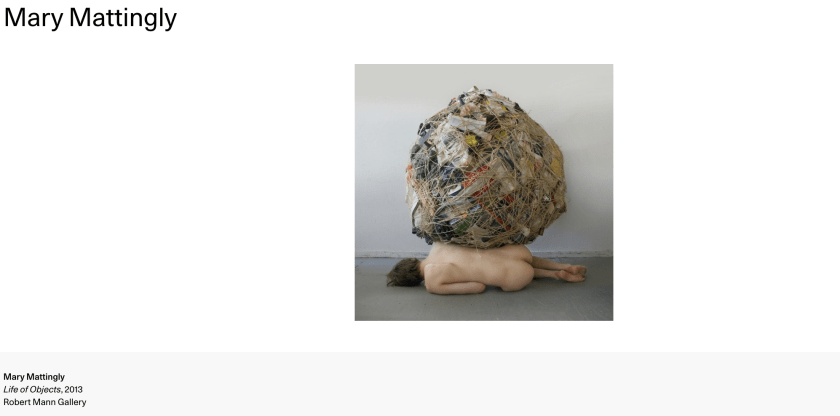
One word that come to mind when I look at this image is BURDEN, I like that the human that is in the work is naked and vulnerable and that they are being almost squashed consumption. The roles have been reversed, the rubbish is the world and the person is the planet. however the string ties both together. Influences of this work could be bundling the found objects together and freezing them, melting the ice so the shape protrudes out. See experiments blog in the future
CLIMATE CHANGE HAS ALREADY TRANSFORMED EVERYTHING ABOUT CONTEMPORARY ART
May 4, 2020 11:56am
“In New York 2140 (2017), sci-fi novelist Kim Stanley Robinson imagines cultural life in a city changed by the warming climate. Rising seas have flooded this future Gotham, transforming much of the five boroughs into an intertidal zone. The two great “pulses” that inundated downtown Manhattan and other low-lying areas had catastrophic effects on citizens of the former financial capital. The tides also ushered in a thriving, anarchic aqua-urbanism.”
The Artists Leading the Conversation on Climate Change
https://magazine.mygobe.com/climate-change-art/
Combating climate change with art: These artists are creating work that highlights and raises awareness about the changing state of our planet.
“Occupying galleries, streets and public spaces, artists have become a mainstream voice with the power to lead discussion and play a universal role in climate discourse.”
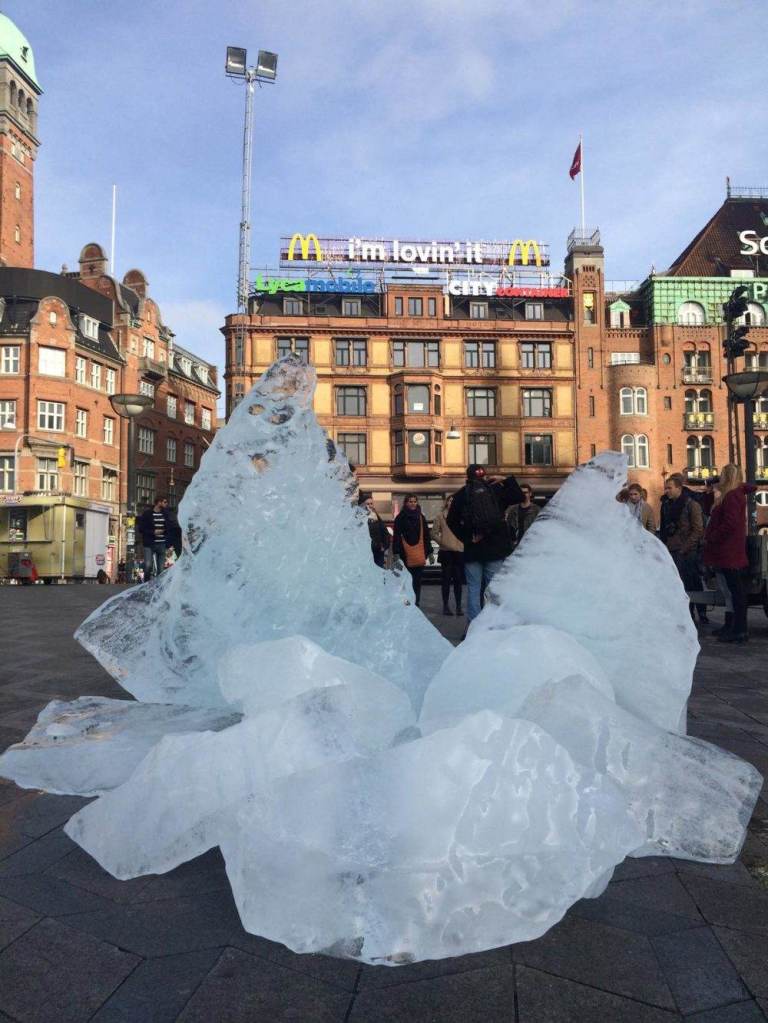
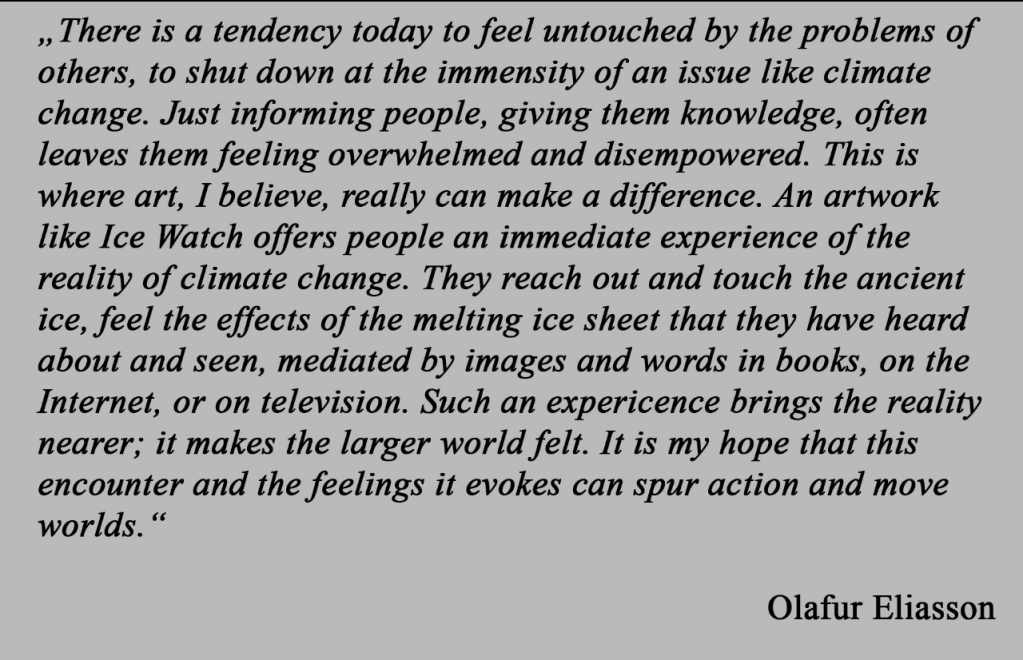
I am a huge fan of Olafur Eliasson, especially his cylindrical sphere work. I think that Eliasson is also great because he is such a well renown artist, he has a captivated audience. What he chooses to show that audience is always hitting goals. This is talked about on so many levels. One of the reasons for choosing to freeze came from his campaign.
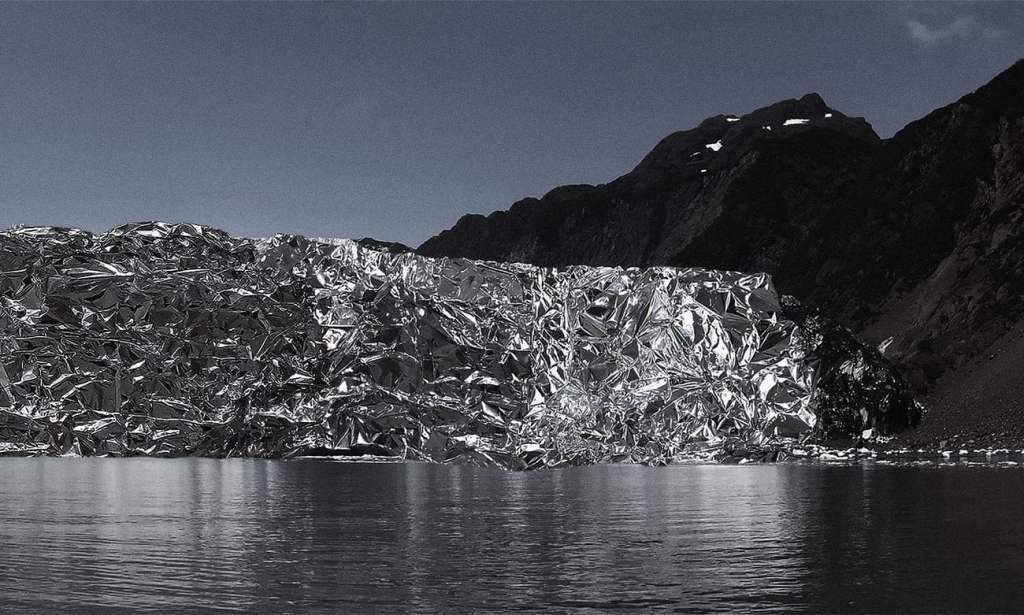
From foil-wrapped glaciers to the Alpine storm cyclist: the artists fighting climate change
https://www.theguardian.com/artanddesign/2019/feb/20/artists-fighting-climate-change
Oliver Krug, Thu 16 Apr 2020 21.33 AEST
“After too long a silence, art is finally tackling global warming. Here are the big players – including the artist who’s lighting up Alaska”
Melting Art
Elisabeth Pilhofer
https://sculpture-network.org/en/art-climate-change-ice-watch-Eliasson
“Whether as an unambiguous and giant sculpture like Olafur Eliasson’s global political statement Ice Watch which, after Copenhagen and Paris, can be experienced in London from 11 December, or as a silent and magical moment on a lake near Hannover as with Frank Nordiek’s and Wolfgang Buntrock’s Ice Virus: Art makes certain things visible and perceptible. It is a thought made physically tangible. It can help us to appreciate the world we live in more – and that is an important step in finding a common approach for topics like climate change that are incomprehensibly huge and thus also overwhelming. “
I Like this representation of ice with colour and that it is not the dominant form in the frame. The work continues to change and re present itself. My influence is the colour, I could consider applying a colour to suggest seepage of pollution for industries that are making plastic. Or I could combine the melted plastic with hard to suggest global warming…inside the melting ice block…see experiments in future
REMEMBER WHEN CONTEMPORARY ART SOLVED THE CLIMATE CRISIS?
THE POINT BY SEAN RASPET FROM MAR/APR 2020
http://artasiapacific.com/Magazine/117/RememberWhenContemporaryArtSolvedTheClimateCrisis
Climate as Content
Not every artwork needs to be about the climate crisis. Nor should it be. That being said, with a recent, sharp increase in climate-change as a topic for artworks and exhibitions, it is necessary to address a sizable gap in the typical perceptions of what a climate-crisis-themed artwork “does” or “accomplishes” and what it is physically and chemically—and, as a result, its actual material effects on the atmosphere. Climate change is, after all, a large-scale physicochemical problem. It is an accumulating flow of gaseous carbon that is immune to our individually held thoughts, beliefs, hopes, and fears. It is responsive to (and constituted by) the emergent phenomena of humans’ collective material activities at a planetary scale.”
18 Green Artists Who Are Making Climate Change And Conservation A Priority
Katherine Brooks , 15/07/2014 11:37 PM AEST | Updated 07/12/2017 2:18 PM AEDT
This was by far my favourite article, Katherine Brooks researched so many great artists, I wonder why it has taken me so long to really delve into this work, I believe it’s fear, I think that far has to be ignored in order to create works that will hopefully encourage thought on such an important subject. These artists have been charging ahead with artworks from this 2014 article and the majority I looked at are gaining momentum with the most amazing ideas art art works, still as environmental artists.
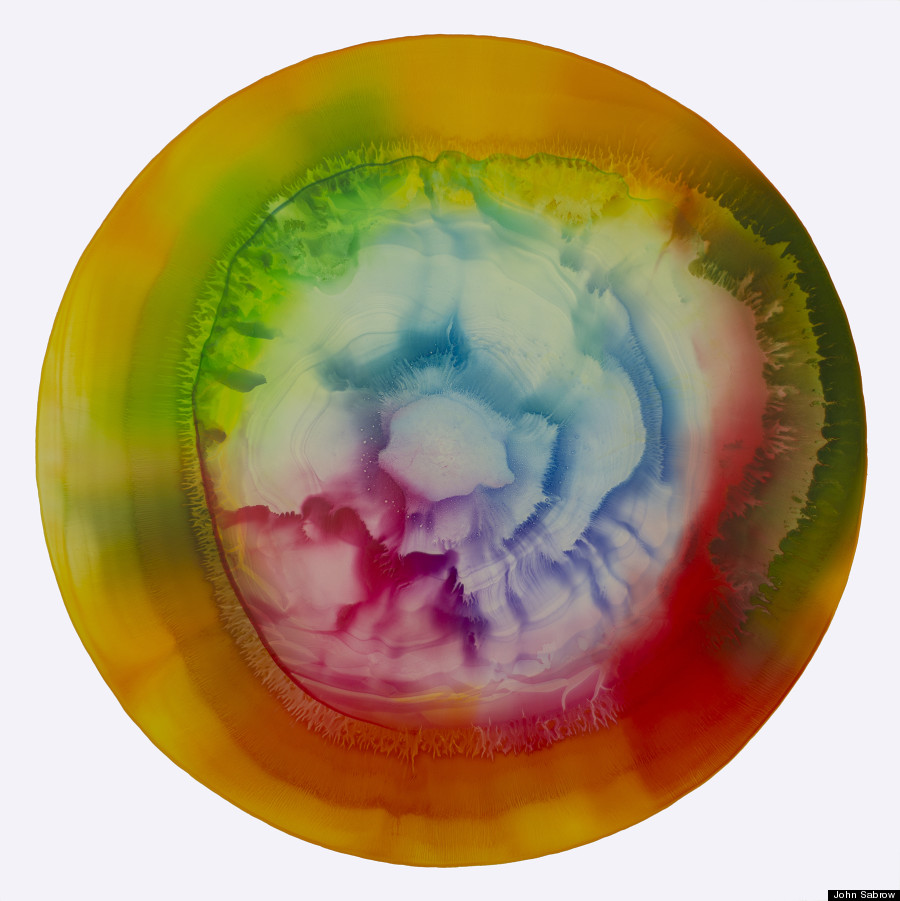
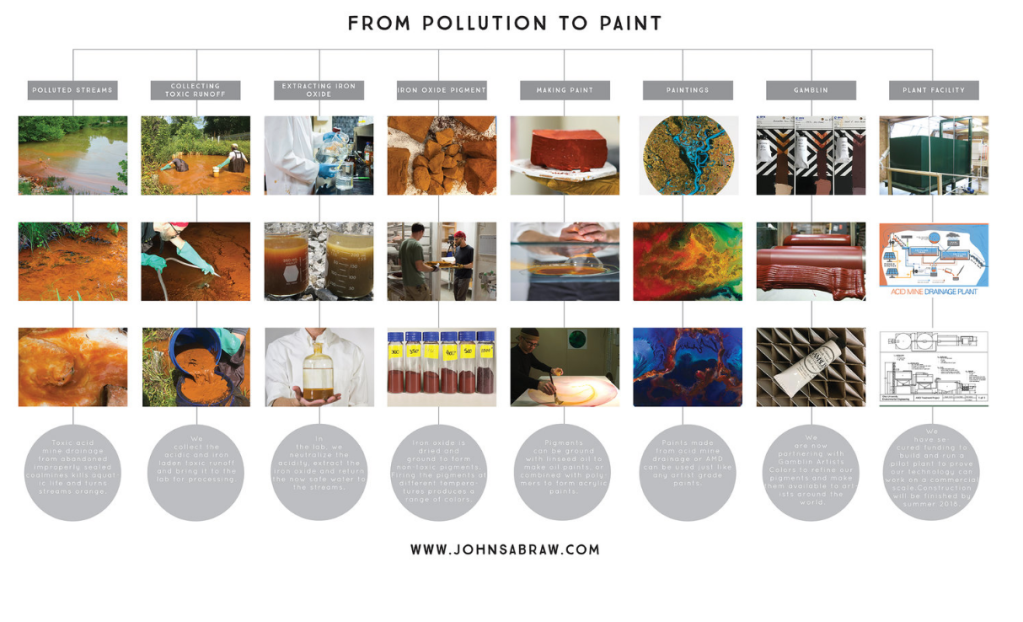
John Sabraw: making pollution paint
“Artist John Sabraw was born in Lakenheath, England. An activist and environmentalist, Sabraw’s paintings, drawings and collaborative installations are produced in an eco conscious manner, and he continually works toward a fully sustainable practice. He collaborates with scientists on many projects, and one of his current collaborations involves creating paint and paintings from iron oxide extracted in the process of remediating polluted streams.”
Naziha Mestaoui : digital art
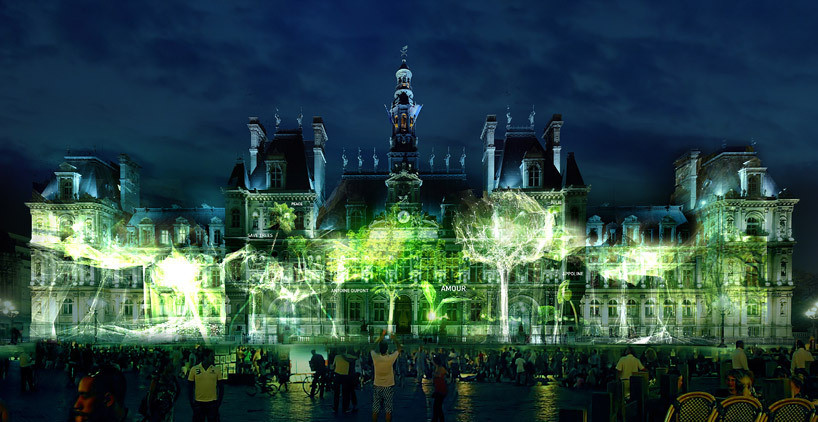
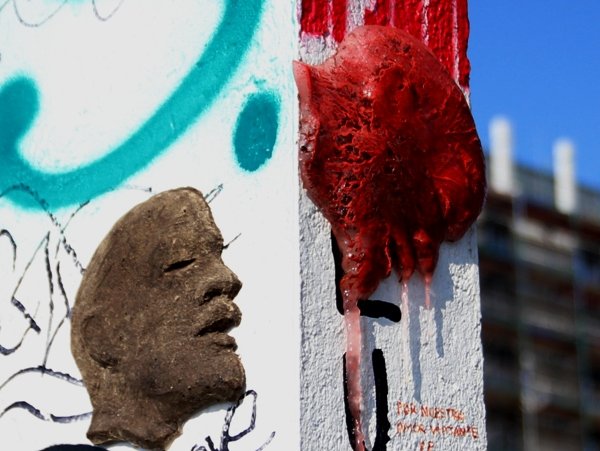
Aida Sulova : uses powerful imagery
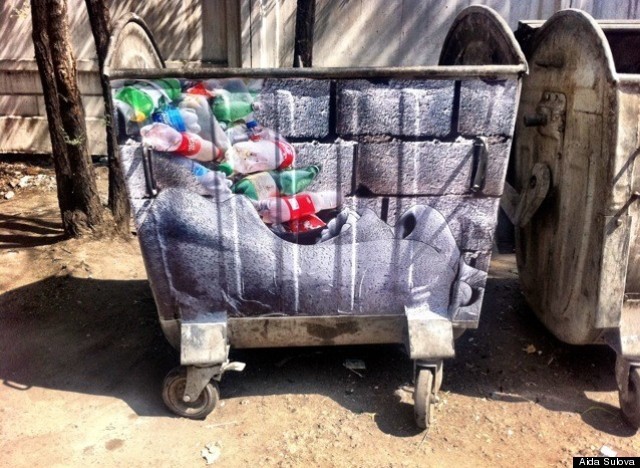
Here’s what Aida Sulova has to say about her project:
‘I wanted to raise awareness about the rampant garbage problem in Kyrgyzstan, I found that the ugly trash cans in the city can actually serve as a nice canvas to express my concern. I made a series of large photographs of the wide open human mouth and I placed them on the sides of the garbage cans around the city. So they would remind people that what they throw into the world, eventually ends up inside us.”
Chris Jordan’s Portraits of Consumption
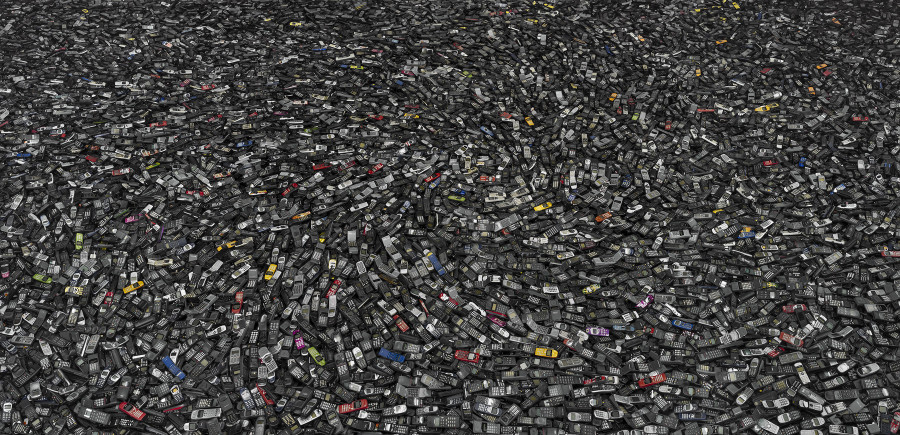
Intolerable Beauty: Portraits of American Mass Consumption(2003 – 2005)
Photographer Chris Jordan puts consumption into perspective with his series “Intolerable Beauty: Portraits of American Mass Consumption.” His works show the debris we as a society leave behind, from massive dumps of cell phones, to crushed cars and circuit boards, all squeezed together in hypnotic quantities. “I am appalled by these scenes, and yet also drawn into them with awe and fascination,” Jordan explained in an email to The Huffington Post. “The immense scale of our consumption can appear desolate, macabre, oddly comical and ironic, and even darkly beautiful; for me its consistent feature is a staggering complexity.”
Gabriel Orozco : isolation

“For the 2012 installation “Sandstars,” Gabriel Orozco arranged over 1,200 objects from the Isla Arena, Mexico trash repository on the Guggenheim Museum’s floor, accompanied by a dozen large, gridded photographs depicting the individual objects in a studio setting. The found treasures bring hints of the ignored wastelands into a gallery setting, forcing viewers to confront the effects of industrial and commercial refuse.”
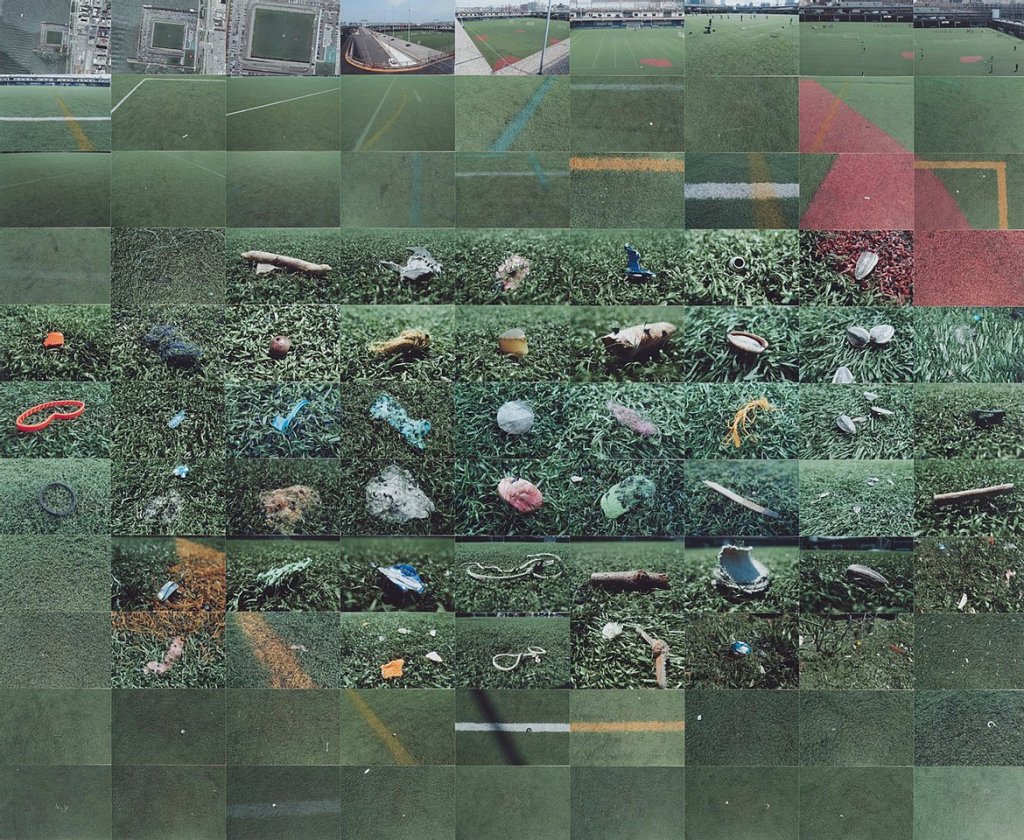
There are two works of Gabriel Orozco I have placed in this blog, they re two separate series, one instigated a museum to commision some of his work similar to Sandstars”2012, which was born from “Astroturf Constellation” 2012. I like them both for completely different reasons, “Sandstars”2012 is pragmatic, clean and displayed with consideration to every single object in mind. While I have been collecting waste, I am constantly reminded that I am just one person and the amount I collect over such a small amount of time astounds me and overwells me to imagine how much is out there. By placing the items in a sterile gallery, they objects are able to paint a bigger picture, it also looks impressive aesthetically which draws views in. The second work I liked because it’s still at the scene of the crime, Orozco leaves the objects where they are found and uses gridding and photo collage to tell a story in an artistic way and it has less of a carbon footprint. I like this as well because brings the idea of one small impact gathered to see the bigger picture..e.g. it’s just gum, it’s just a cigarette butt or wrapper and so on, but combined with all the other simple items its metamorphosis. At this stage I am not sure if these will directly influence me, however I am using photography as delivery and I definitely want it to be clean and pragmatic to get the best viewer impact.
Mathilde Roussel : grows
French artist Mathilde Roussel created a series of living grass installations that take the shape of human beings. Made of recycled material and fabric filled with soil and wheat grass seeds, the pieces are meant to symbolize the centrality of food. “Observing nature and being aware of what and how we eat makes us more sensitive to food cycles in the world — of abundance, of famine — and allows us to be physically, intellectually and spiritually connected to a global reality,” the artist explains.
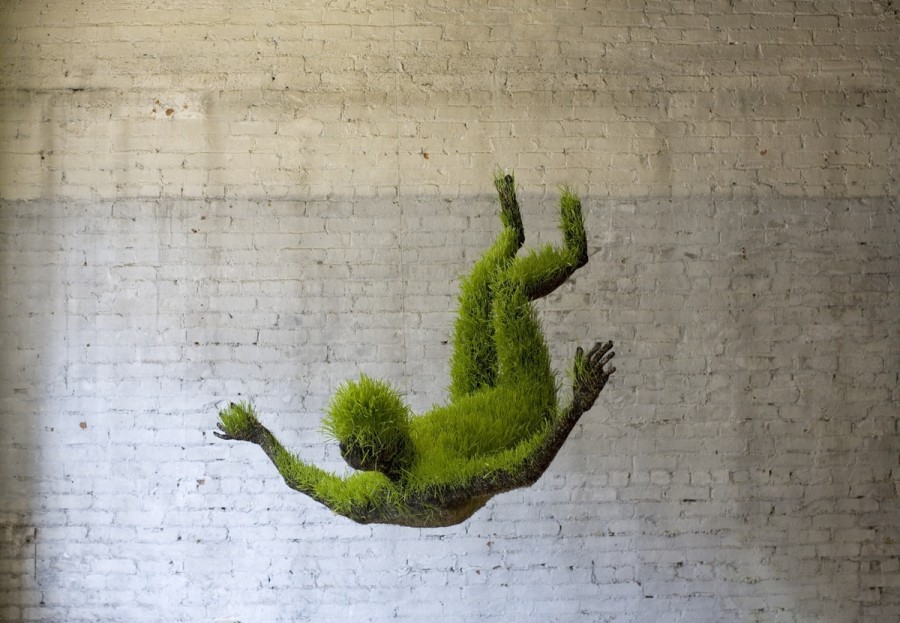
I was influences by Mathilde Roussel because of the idea of growth and the context of the processes it goes through during her exhibition. I wanted to experiment with the amount of straws I have been collecting, attempting a juxtaposition of nature and the pollution it is trying to engulf and break down. another option could be placing flowers in the straws, they could resemble all the faces of the people that have drunk them… I like the straws representing the people as it is a very individual plastic item. See future experiments with straws…

 CAVA 390